Reading list
Best astronomy books
for beginners
A good book on astronomy will teach you more in an evening than hours of unfocused searching online. Here is what to read and why.
This page contains affiliate links. As an Amazon Associate I earn from qualifying purchases.
Two types of astronomy book
Astronomy books fall into two broad categories, and knowing which you need saves money and frustration.
The first type is the practical observing guide - a book about what to point a telescope or binoculars at, where to find it, and what to expect when you do. These are written for people standing in a dark field with a telescope. They contain charts, sketches of what objects actually look like through an eyepiece, and step-by-step directions for navigating from one object to the next.
The second type is the popular science book - an explanation of what the objects actually are, what physics governs them, and what the current state of knowledge says about them. These are read in an armchair. They complement observing guides by giving context to what you are looking at.
Most beginners benefit from one of each. The observing guide gets used at the telescope; the popular science book gets read between sessions.
Why a book beats a search engine
Online guides to astronomy tend to assume either very little prior knowledge or a great deal. A curated book written by a practising observer structures the information correctly for the stage you are at - starting from naked-eye orientation and building toward more demanding targets as skill develops.
Books also do not change. A well-written observing guide from five years ago is just as accurate as one published today. The stars do not move on human timescales. The annual guides are the exception: these update each year to show the positions of planets and other time-variable objects, so buying the current edition matters.
Which books to read

The definitive beginner's observing guide for small telescopes. Every object is shown as it will actually appear through an eyepiece - sketched, not photographed - so there is no mismatch between expectation and reality. Directions are given relative to recognisable star patterns, building navigation skill rather than dependence on a computerised mount. This is the first book to buy.
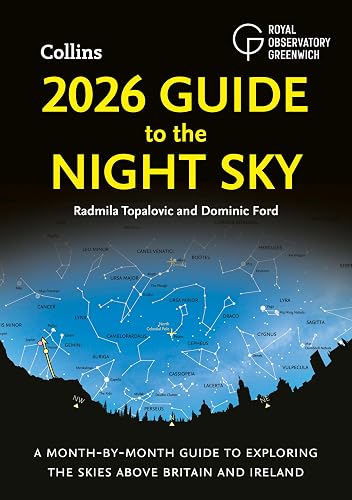
A compact month-by-month guide written for observers in Britain and Ireland. Each month covers which constellations are prominent, where the planets are, and any notable events (meteor showers, oppositions, conjunctions). Small enough to sit beside a planisphere on the observing table. Updated annually, so buy the current year's edition.

Neil deGrasse Tyson's short, accessible primer on the physics behind what you observe. Short chapters cover dark matter, dark energy, the cosmic microwave background, the Big Bang, and the chemical elements - the conceptual scaffolding that makes sense of what a telescope is actually looking at. Read this after a few sessions at the eyepiece, not before.