Buying guide
Best beginner telescopes
for astronomy
The right first telescope is one you will actually use. Here is what to look for and which models are worth buying.
This page contains affiliate links. As an Amazon Associate I earn from qualifying purchases.
Aperture: the only spec that matters
A telescope's aperture is the diameter of its main lens or mirror, measured in millimetres. It determines how much light the instrument collects. More aperture means fainter objects become visible and brighter ones show finer detail.
Magnification is far less important than manufacturers tend to suggest. Any telescope can magnify more by swapping to a shorter eyepiece, but it cannot gather light it does not have the optics for. High magnification on a small aperture produces a large, blurry image. Moderate magnification on a larger aperture produces a sharp one. When comparing telescopes, look at the aperture first and ignore the magnification claims on the box.
As a practical guide: 76mm is enough to resolve Jupiter's main cloud bands and its four largest moons, the Moon's craters in useful detail, and the brighter star clusters. A 130mm aperture opens up fainter targets - the Orion Nebula starts to look impressive, and Saturn's rings appear with real clarity.
Reflectors and refractors
Beginner telescopes come in two main optical designs. A refractor uses a glass lens at the front. A reflector uses a curved mirror at the back. At any given price, reflectors deliver more aperture for the money, because mirrors are cheaper to manufacture accurately than lenses of the same size.
Refractors offer a slight edge on contrast for planetary viewing and require less maintenance - the optics are sealed and do not need realignment. Reflectors need collimating (aligning the mirrors) occasionally, though most beginner designs make this quick. At entry-level price points, the aperture advantage of a reflector outweighs these considerations for most buyers.
What you will actually see
The night sky through a telescope looks nothing like astrophotography. Galaxies and nebulae appear as faint grey smudges, not the vivid colours produced by cameras with long exposures. Planets are small discs, not the enormous features shown in observatory images.
This does not mean the experience is disappointing - it means expectations need calibrating. The Moon looks spectacular at almost any magnification. Saturn's rings resolving into an unmistakable shape is a moment most observers remember clearly. Jupiter's moons shift position from night to night.
Near-Earth asteroids tracked on this site are far too faint for amateur instruments. The close-approach list will not point you toward anything visible in a backyard telescope. The wider sky, though, contains more than a lifetime's worth of targets.
Which telescope to buy

The most affordable entry point. A compact tabletop Dobsonian that needs no tripod and takes seconds to set up. It handles bright targets well: the Moon, planets, and the brighter star clusters. A sensible first purchase before committing to something larger.
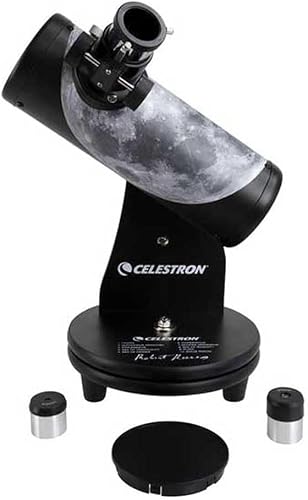
The same optical design as the standard Firstscope, with a better pair of included eyepieces (20mm and 4mm) giving a more useful range of magnifications straight out of the box. Worth the small step up if budget allows.
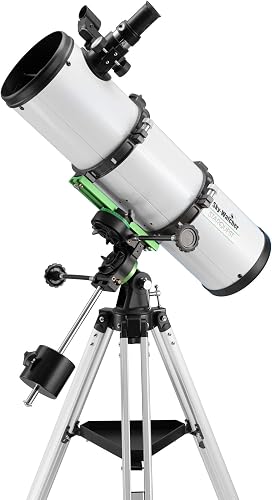
A 130mm parabolic Newtonian on an alt-azimuth mount. The parabolic mirror eliminates the edge-of-field distortion present in cheaper spherical-mirror designs and produces noticeably sharper images. At this aperture, objects that were invisible in the 76mm scopes become accessible - fainter nebulae, more detail on the planets, and double stars that were previously unresolvable. Buy this if you are already confident you want to pursue the hobby.